Barefoot play
Should we let children play in their bare feet?
yes!
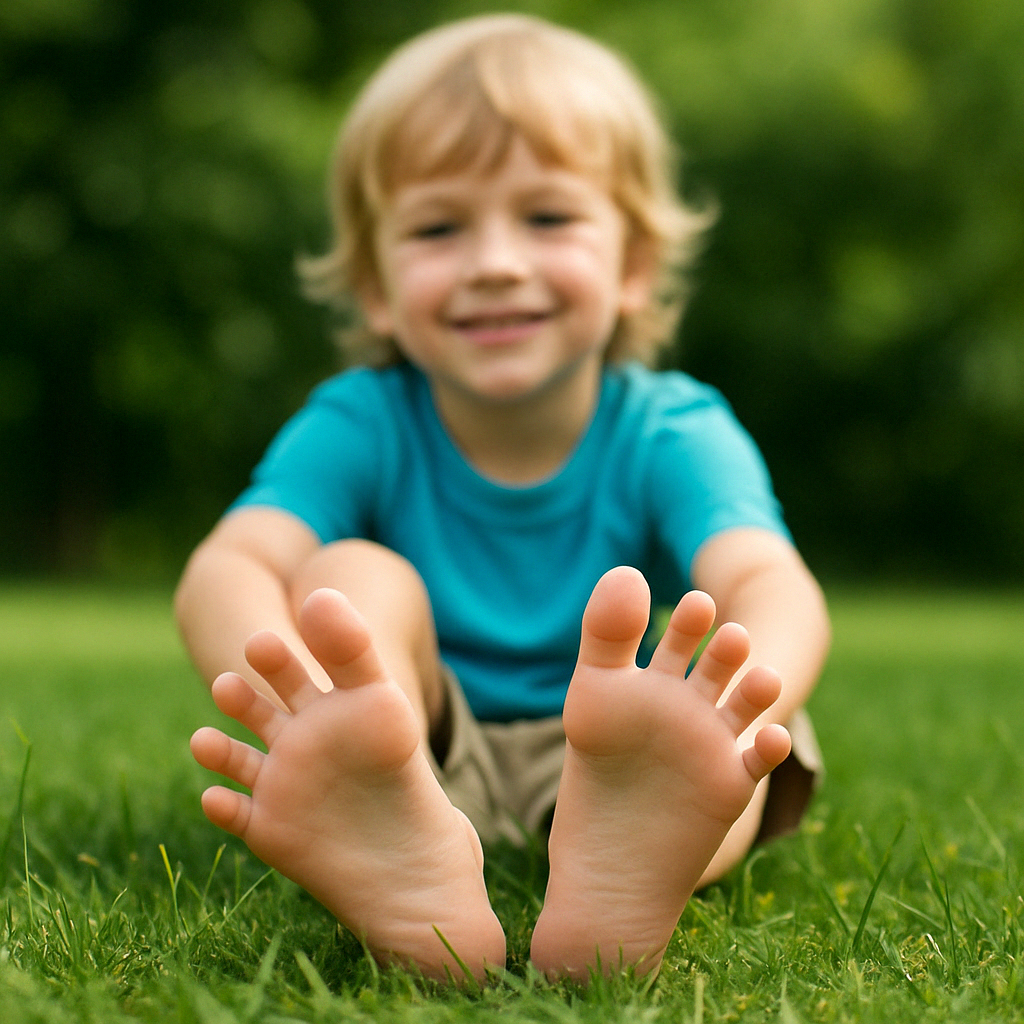
The longer answer is that there are so many benefits to barefoot play.
Flegal (2019) talks about how going barefoot stimulates both the proprioceptive and vestibular systems, the parts of the nervous system that help children with balance, body awareness and movement control.
With feet having as many nerve receptors as the entire spine, it’s important that children have the opportunity to feel the ground in order to learn how to navigate it properly and safely (Flegal, 2019).
There are lots of gross motor benefits linked to barefoot play as children grow.
Research even suggests it can help improve running, jumping and balancing skills (Zech et al., 2018).
These kinds of physical abilities do more than support healthy movement, they help children build friendships too, by giving them the confidence to join in with physical play and connect with their peers (White, 2015).
The social connection this brings is important.
It can boost communication, build confidence, and support a strong sense of wellbeing and self-esteem (White, 2015).
On top of that, there’s the suggestion that being barefoot in nature helps children feel more connected to the natural world (Flegal, 2019), something we know is hugely valuable for emotional wellbeing (Cree and Robb, 2021).
In fact, the foot itself is a perfectly designed part of the body, with natural spring, grip, and shock absorption built in.
Walking barefoot lets children use the full structure of the foot as it was meant to be used. It helps develop strong arches, supple ligaments, and proper posture by allowing the toes to spread and flex, the muscles to work, and the foot to move naturally (White, 2015, p. 44; Howell, 2010, p. 45).
The sensory information children receive through their bare feet also plays a huge role in balance and coordination.
The brain constantly responds to signals from the soles of the feet, adjusting movement to suit different textures and surfaces, something shoes can significantly dull (White, 2015, p. 43; Brand, quoted in McDougall, 2010, p. 177).
Does anyone else remember running around the house in socks or bare feet?
Or playing in the garden and feeling the grass under your toes?
How about coming home from school and ripping those shoes off the second you walked through the door, leaving them for your mum and dad to pick up after you?
I definitely do!
Turns out this is quite the natural behaviour for a child and something they’re instinctively driven to do.
As Howell put it, "Children have an instinctive understanding that shoes are unnatural" (Howell, 2010, p. 82, cited in White, 2015, p. 45).
When it comes to the early years setting, the question can fast become a safeguarding one.
A common concern is: what if there’s a fire emergency and the children don’t have their shoes on?
This is a valid concern, of course, but a risk like this can be effectively managed with a thorough risk assessment.
In this case, a risk-benefit analysis may be the more helpful approach.
This is a form of assessment described by Cree and Robb (2021), where instead of looking solely at the risks, we also consider the developmental benefits and weigh up whether those benefits justify the risk.
After all, current early years policy recognises measured risk as a key part of high-quality provision.
The Birth to 5 Matters guidance supports this by highlighting the importance of allowing children to explore and take risks in order to grow into capable, resilient learners (Early Education, 2021).
Similarly, the statutory Early Years Foundation Stage framework asks providers to manage risk rather than eliminate it, and to show how the risks are being balanced against the child’s developmental needs (Department for Education, 2024).
Maybe we need to ask ourselves, as practitioners and parents:
Are we putting shoes on them out of habit, or because it makes life easier for us?
Or have we actually stopped to consider what would benefit the child in that moment?
No one is saying, “Let’s walk our children down the road in bare feet.”
But maybe, just maybe, we can create safe opportunities for bursts of barefoot physical play throughout the day (White, 2015).
This could be as simple as a soft play area where children can take their shoes off, or barefoot walks on grassy areas with hills, lumps and bumps… and dare we say, the odd muddy puddle or two?
As adults, we should be joining in the barefoot play too.
By getting involved ourselves, we’re not only modelling it, but we might even end up enjoying it as much as the children!
White puts it perfectly in Every Child a Mover:
"The simple fact is that the children’s own bodies tell them what they need to be doing, and they are driven to do what is currently required. They are biologically ‘programmed’ to seek the appropriate physical experiences: our job is to make these safely available for as much time as possible.” (White, 2015, p. 7)
References
Flegal, K. (2019) ‘Barefoot Babies’, Natural Child Magazine. Available at: https://www.life.ca/naturalchild/1210/barefoot-babies.htm.
White, J. (2015) Every child a mover: a practical guide to providing young children with the physical opportunities they need. London: The British Association for Early Childhood Education.
Zech, A. et al. (2018) ‘Motor Skills of Children and Adolescents Are Influenced by Growing up Barefoot or Shod’, Frontiers in Pediatrics, 6, p. 115. Available at: https://doi.org/10.3389/fped.2018.00115.
Department for Education (DfE) (2024) Statutory framework for the early years foundation stage: Setting the standards for learning, development and care for children from birth to five. Available at: https://www.gov.uk/.../early-years-foundation-stage...(Accessed: 22 April 2025).
Early Education (2021) Birth to 5 Matters: Non-statutory guidance for the Early Years Foundation Stage. Available at: https://www.birthto5matters.org.uk (Accessed: 22 April 2025).
Brand, P., quoted in McDougall, C. (2010) Born to Run: The hidden tribe, the ultra-runners, and the greatest race the world has never seen. London: Profile Books.
Howell, D. (2010) The Barefoot Book: 50 great reasons to kick off your shoes. Chanhassen, MN: Hunter House.